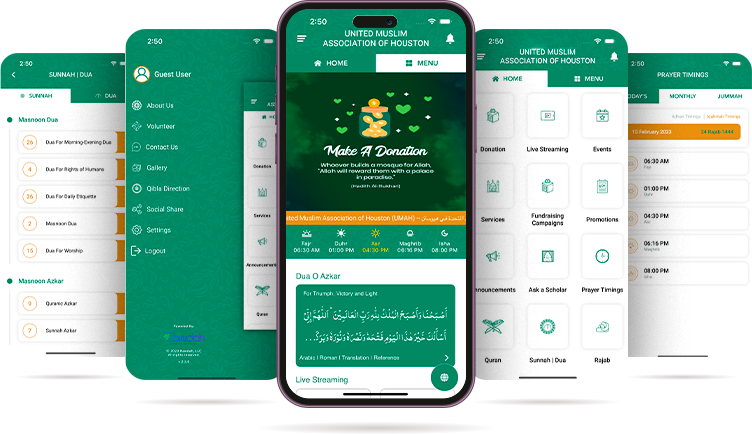
The United Muslim Association of Houston (UMAH) is a nonprofit organization in Houston, Texas. UMAH started in October 1993 when a group of West African immigrants residing in Houston, Texas came together to form an Islamic organization. While most of the attendees of the meeting were Sierra Leoneans, there were also Gambians, Liberians, Guineans and Senegalese. The main initiator behind the idea to form an organization, Br Mohamed Seray Jarr, was appointed as the tentative leader & Imam of the organization in November of 1993. He was the one who suggested the name “United Muslim Association of Houston” for the organization, and this was accepted by everyone.
From that humble beginning to now, UMAH had gone through a series of transformations and changes, and under different leadership teams. UMAH was formally registered in the state of Texas in 1994. In 1996 the organization rented a place for performing salah, conducting meetings and for weekend Islamic school. Before this time meetings used to be held at members’ residents. Having lost the rental place, it became once again the norm to hold functions and meetings at members’ residents. From 2009 to 2013, all UMAH functions and meetings were held at the residence of Br Brima Amadu and Br Senesie Sheriff.
In 2013 UMAH bought a residential place at 4127 Wildacres Drive, Houston, Texas. UMAH is open to all people. Our
mission is to establish and maintain a vibrant community based on the Quran and Sunnah, through programs that support the religious, social and educational advancement of Muslims we serve. It also includes establishing and strengthening relationships with other Muslims and non-Muslim organizations that share our values. We aim to serve Allah and practice Islam as a total way of life.
The biggest challenge of UMAH since its inception has been to have a Masjid facility for its community. While the residential place the organization bought on Wildacres drive has been a relief, it has not been without its own challenges. This is presently our center where we conduct all our functions: Salah and Jumah prayers, Halaqah for sisters and for the community, weekend school for children, Iftar during Ramadan, and community gatherings. The biggest drawback of our current location is that it has become too small for us and there is no way for expansion. Secondly, there is not enough parking for our congregation. A series of angry protests from the neighbors with police involvement in some of these encounters in Ramadan of 1438 (2017) led the leadership to seek refuge in Masjid Al Anbiyaa for all of Ramadan 1439 (2018). Although we came back to our center to observe Ramadan 1440 AH (2019), it was with great precautions including Houston police officers serving as guards throughout the blessed month.